How to Set Up a PET Blow Moulding Line, A Practical Setup Guide
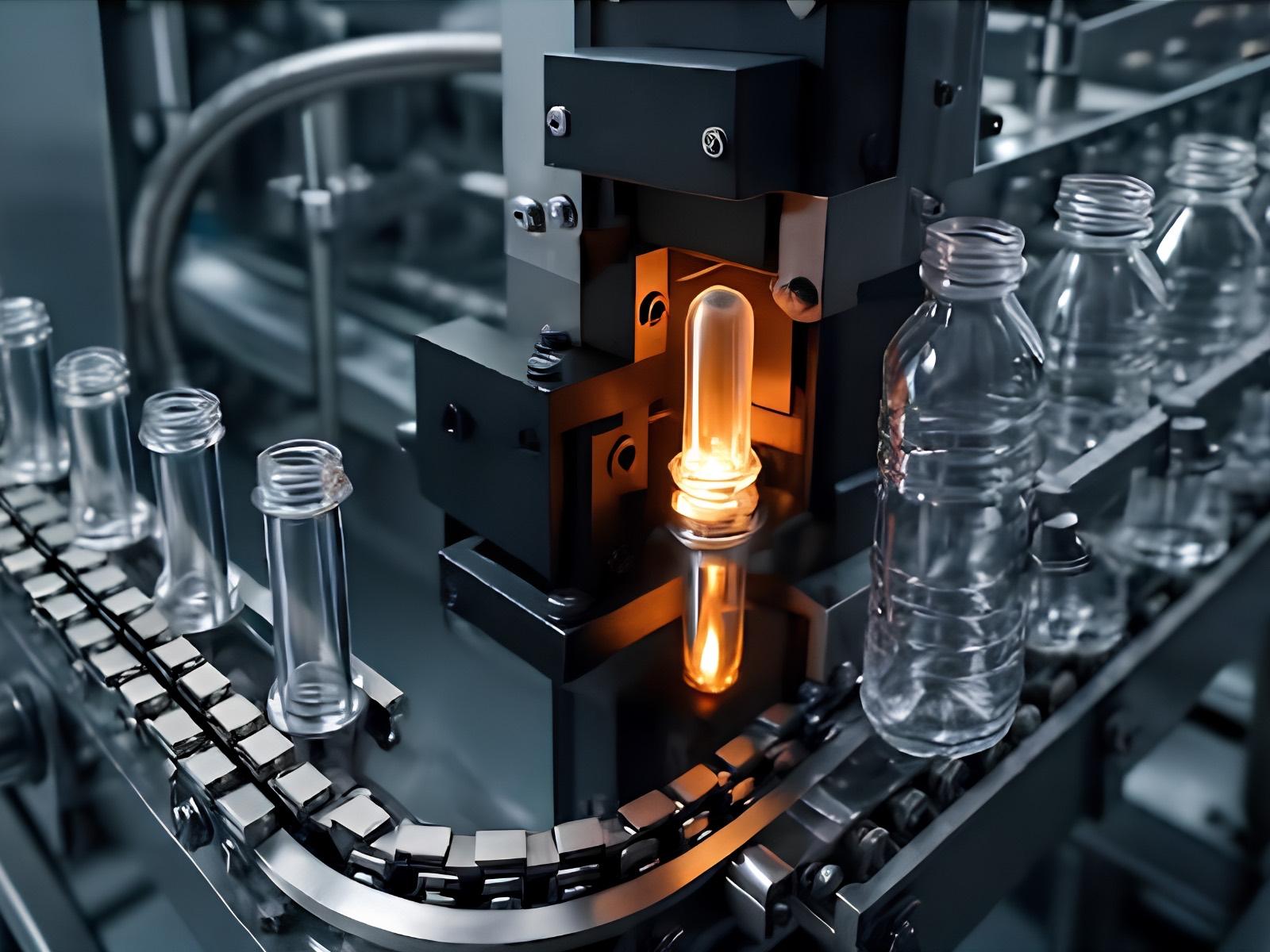
When does an in-house PET blow moulding line make sense?
If your bottling line consumes more than 20,000 bottles per day, in-house blow moulding starts paying off, both in per-bottle cost (you save ₹0.30-0.60 per bottle vs. external preform-to-bottle conversion) and in operational control.
Below 20,000 bottles per day, external sourcing of preforms is usually fine; in-house blow moulding adds capex without proportionate ROI.
Step 1: Match the blow moulding output to your filling line
The cardinal rule: blow moulding throughput = filling line throughput × 1.20 (the 20% buffer absorbs changeovers, rejection and start-up).
| Filling line | Recommended blow moulding |
|---|---|
| 30 BPM | Semi-auto 1-cav (1,200 BPH) |
| 60 BPM | Linear 4-cav (4,200 BPH) |
| 90 BPM | Linear 4-cav high-speed or linear 6-cav (6,500 BPH) |
| 120 BPM | Rotary 6-cav (8,000 BPH) |
| 240 BPM | Rotary 8-cav (12,500+ BPH) |
| 480 BPM | Rotary 12-cav (16,000+ BPH) |
Step 2: Choose linear or rotary
Rule of thumb: rotary above 8,000 BPH, linear below.
Linear is simpler, cheaper, and easier to service. Rotary is mandatory for high-speed continuous operation (24x7) and gives tighter wall-thickness control.
Read the linear vs rotary comparison for the full breakdown.
Step 3: Plan for mould inventory
Each bottle SKU needs its own mould. Typical inventory for a water plant covering 200ml, 500ml, 1L and 2L:
- 4 mould sets × ₹1.8-2.5 Lakhs per cavity × cavity count
- For a 4-cavity line covering 4 SKUs: 4 × 4 × ₹2L = ₹32 Lakhs in mould inventory
Quick-change tooling reduces changeover from 50 min to 25 min, worth the 8-12% mould premium.
Step 4: Source preforms reliably
Indian preform suppliers (most-used by our customers):
- Reliance Sila series, high IV stability, premium price
- Indorama RamaPET, most-installed
- IVL preforms, solid mid-tier
- Local suppliers, variable quality, useful for non-critical SKUs
Standard neck finishes:
- PCO 1810, most-popular for water (28mm)
- PCO 1881, lightweight (28mm, lower closure)
- 30/25 ROPP, for sparkling / CSD
- 38mm crown, for jars
Always validate preforms with your blow moulding machine before locking large orders.
Step 5: Compressed air infrastructure
This is the biggest hidden capex on a PET blow moulding line.
- HP air: 25-35 bar, used for the actual blowing
- LP air: 7-8 bar, used for valves and pneumatics
- Air consumption: 1.0-1.4 Nm³ HP per kg of PET preform
- Compressor: ₹6-12 Lakhs for a typical 60 BPM-equivalent line
- Air receiver tank: 2,000-5,000 L
- Refrigerated dryer: mandatory (moisture in air ruins bottles)
- Air recovery system: saves 35-40% on compressor electricity (8-14 month payback)
Step 6: Electricity & utilities
| Line | Power load | Chiller | Air dryer |
|---|---|---|---|
| Semi-auto 1-cav | 15 kW | 3 TR | Standard |
| Linear 4-cav | 55 kW | 8 TR | Standard |
| Rotary 6-cav | 95 kW | 15 TR | Standard |
| Rotary 8-cav | 140 kW | 20 TR | Heavy-duty |
Voltage stabiliser is mandatory in most Indian industrial belts (especially Tier-2/3 cities).
Step 7: Commissioning & ramp-up
A well-planned blow moulding installation takes 4-6 weeks from PO to first-bottle production:
- Week 1-2: Machine delivery, civil readiness
- Week 3: Erection, utility commissioning
- Week 4: Cold trial, mould fit, parameter setting
- Week 5: Hot trial, ramp to nameplate output
- Week 6: Operator training, handover
Plan for 25-35% lower output in week 5, operators take 4-6 weeks to reach steady-state OEE.
Common setup mistakes
- Undersized compressor, leads to chronic low-pressure issues and bottle wall defects.
- Skipping the chiller, moulds run hot, bottle quality drops, cycle time extends.
- No air dryer, moisture in HP air = milky / cloudy bottles.
- Cheap mould tooling, saves ₹2-3 Lakhs upfront, costs ₹5-8 Lakhs in rejections per year.
- Ignoring preform IV variation, leads to wall thickness variation and BIS rejection.
Bottom line
A well-set-up PET blow moulding line pays back in 12-16 months when paired with a captive bottling operation. The setup decisions, output sizing, linear vs rotary, mould inventory, air infrastructure, drive 80% of long-term operating economics. Cut corners on these and you'll pay 3-5x in operating cost over the first 24 months.